

Breast Cancer
What is Breast Cancer?
Understanding Breast Cancer
Cancer is a broad term for a class of diseases characterized by abnormal cells that grow and invade healthy cells in the body. Breast cancer starts in the cells of the breast as a group of cancer cells that can then invade surrounding tissues or spread (metastasize) to other areas of the body.
What causes cancer to develop?
Cancer begins in the cells which are the basic building blocks that make up tissue. Tissue is found in the breast and other parts of the body. Sometimes, the process of cell growth goes wrong and new cells form when the body doesn’t need them and old or damaged cells do not die as they should. When this occurs, a build-up of cells often forms a mass of tissue called a lump, growth, or tumor.
Breast cancer occurs when malignant tumors develop in the breast. These cells can spread by breaking away from the original tumor and entering blood vessels or lymph vessels, which branch into tissues throughout the body. When cancer cells travel to other parts of the body and begin damaging other tissues and organs, the process is called metastasis.
Breast Cancer Facts & Stats
1 in 8 women in the United States will be diagnosed with breast cancer in her lifetime. In 2025, an estimated 316,950 women and 2,800 men will be diagnosed with invasive breast cancer, and an additional 59,080 new cases of non-invasive (in situ) breast cancer will be diagnosed. Chances are, you know at least one person who has been personally affected by breast cancer.
But there is hope. When caught in its earliest, localized stages, the 5-year relative survival rate is 99%. Advances in early detection and treatment methods have significantly increased breast cancer survival rates in recent years, and there are currently over 4 million breast cancer survivors in the United States.
Awareness of the facts and statistics surrounding breast cancer in the United States is key in empowering individuals to make informed decisions about their health.
What causes Breast Cancer growth?
There is much that we know and much that we have yet to understand. However, we do know that cancer spreads in three important ways:
- Damaged cells replicate, creating more damaged cells and tumor growth.
- Our body’s hormones and chemicals can accelerate the growth of some tumors.
- Lymph and blood vessels can carry the cancer to others areas of the body, and lymph node examination can help pinpoint the progression of the disease.
Healthy cells are the basic building blocks of all tissue and organs in the body. But when cell DNA (the cell’s wiring) is damaged, mutated cells begin to rapidly reproduce without following the pre-wired plan. Aggressive cell growth can form a tumor (or mass of tissue) that does not function as originally intended. These abnormal cells or groups of cells can progress into the disease known as breast cancer and can spread to other parts of the body.
Accelerated Growth
The growth and spread of breast cancer can be difficult to grasp because cancer cell growth is often fueled by normally healthy chemicals of the body, like estrogen, progesterone, and the HER2/neu gene (a growth hormone). Although each of these three bodily chemicals can serve an important healthy function, when a cell becomes cancerous these chemicals can accelerate the growth of breast cancer tumors. These are known as prognostic factors of the breast cancer cells.
Healthy HER2 receptors are the proteins that help manage how a breast cell grows, divides, and repairs itself. However, in about a quarter of all breast cancer patients, the HER2 gene isn’t functioning properly. It makes an excess number of copies of itself in a process known as “HER2 gene amplification.” Then these extra genes instruct the cells to make too many HER2 receptors, which is called “HER2 protein overexpression.” The ultimate result is that breast cells grow and divide in an uncontrolled fashion.
Cancer Receptors
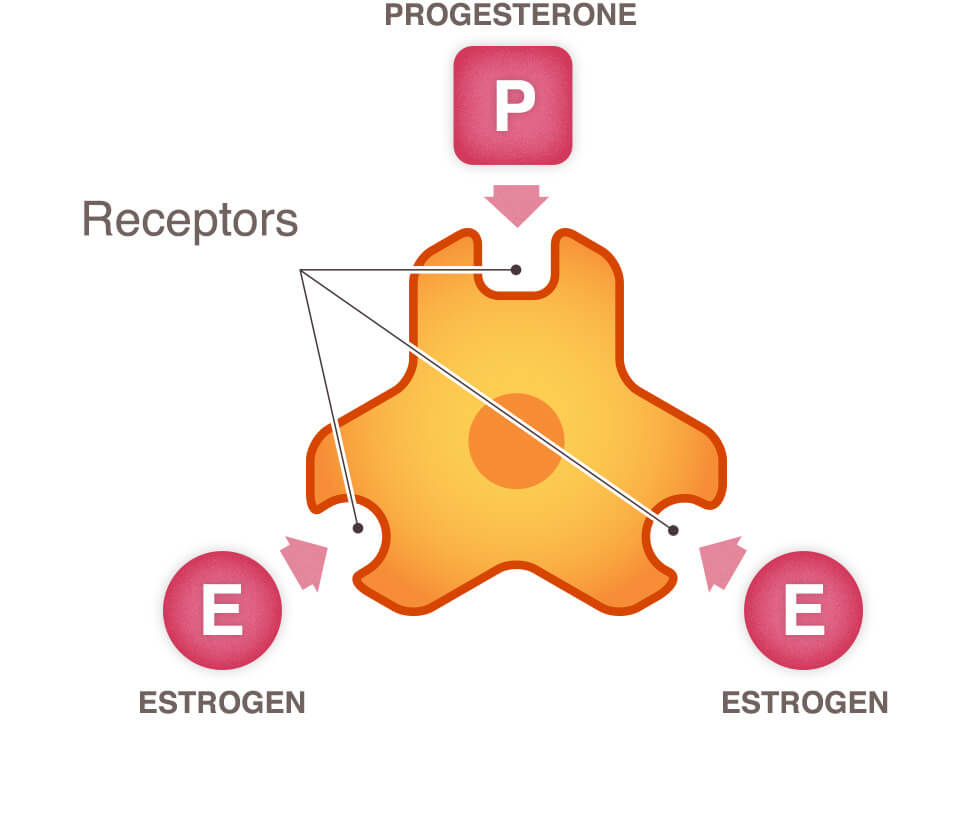 Think of a receptor as a mouth. When open, cancer cells can feed and grow. When blocked off or closed, the same cells begin to starve.
By identifying the cancer’s unique receptors, your doctor can recommend effective treatment methods to block the receptors. Remember, inhibiting the cancer’s “food supply” works to restrict the cancer’s growth. Ideally, your treatment plan will stop the cancer growth before it spreads through the lymph system and on to other tissue and organs in the body.
The Lymph System
The lymph system, which is part of the immune system, is a network of lymph vessels and lymph nodes running throughout the entire body. Similar to how the blood circulatory system distributes elements throughout the body, the lymph system transports disease-fighting cells and fluids. Clusters of bean-shaped lymph nodes are fixed in areas throughout the lymph system; they act as filters by carrying abnormal cells away from healthy tissue.
The lymph system, which is part of the immune system, is a network of lymph vessels and lymph nodes running throughout the entire body. Similar to how the blood circulatory system distributes elements throughout the body, the lymph system transports disease-fighting cells and fluids. Clusters of bean-shaped lymph nodes are fixed in areas throughout the lymph system; they act as filters by carrying abnormal cells away from healthy tissue.
The type of breast cancer is generally determined by the origin of the growth of cancer cells, which is almost always in the lobes, lobules, or ducts. When cancer is found in the nearby lymph nodes, it helps doctors identify just how far the cancer has spread. If the nearest nodes contain cancer, additional nodes are usually examined for the presence or absence of cancer cells to understand how far the disease has progressed.
There are situations in which the bloodstream transports breast cancer cells from the breast to other parts of the body as well. The pathologist looks closely at the breast cancer cells to see if there is angio invasion, meaning blood vessels running through the tumor, and/or lymphatic invasion, meaning lymphatic vessels running through the tumor. When present, there is an increased risk of the cancer being able to spread to other parts of the body.
Risk Factors
What does scientists actually know about the cause of breast cancer?
Cancer grows when a cell’s DNA is damaged, but why or how that DNA becomes damaged is still unknown. The damage could be caused by genetic or environmental and lifestyle factors, or in most cases, a combination of the two. Most patients will never know exactly what caused their cancer. However, there are certain established risk factors that are associated with breast cancer.
Genetic risk factors are inherited, or passed down, from parent to child through the genes. These risk factors cannot be changed because they are built into your DNA from birth. Environmental and lifestyle risk factors are avoidable risk factors that are typically under an individual’s control. These risk factors can be reduced by changing elements within your environment or making alterations to your lifestyle.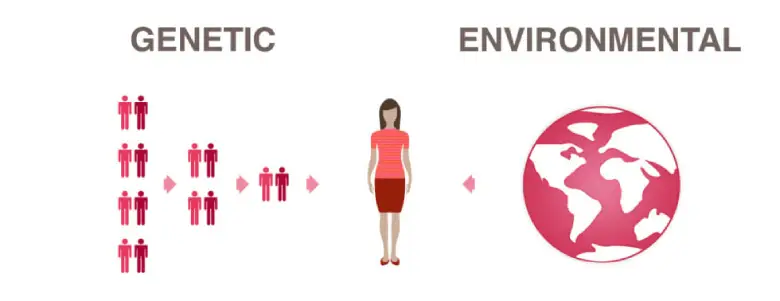
Genetic Risk Factors
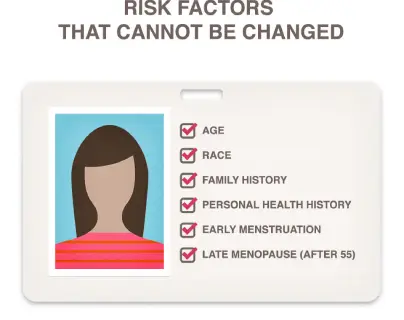 Genetic risk factors that cannot be changed may include:
- Gender: Breast cancer occurs nearly 100 times more often in women than in men.
- Age: Two out of three women with invasive cancer are diagnosed after age 55.
- Race: Breast cancer is diagnosed more often in Caucasian women than women of other races.
- Family History and Genetic Factors: If your mother, sister, father, or child has been diagnosed with breast or ovarian cancer, you have a higher risk of being diagnosed with breast cancer in the future. Your risk increases if your relative was diagnosed before the age of 50.
- Personal Health History: If you have been diagnosed with breast cancer in one breast, you have an increased risk of being diagnosed with breast cancer in the other breast in the future. Also, your risk increases if abnormal breast cells have been detected before (such as atypical hyperplasia, lobular carcinoma in situ (LCIS) or ductal carcinoma in situ (DCIS)).
- Menstrual and Reproductive History: Early menstruation (before age 12), late menopause (after age 55), having your first child at an older age, or never having given birth can increase your risk for breast cancer.
- Certain Genome Changes: Mutations in certain genes, such as BRCA1 and BRCA2, can increase your risk for breast cancer. This is determined through a genetic test, which you may consider undergoing if you have a family history of breast cancer. Individuals with these gene mutations can pass the gene mutation onto their children.
- Dense Breast Tissue: Having dense breast tissue can increase your risk for breast cancer and make lumps harder to detect. Several states have passed laws requiring physicians to disclose to women if their mammogram indicates that they have dense breasts so that they are aware of this risk. Be sure to ask your physician if you have dense breasts and what the implications of having dense breasts are.
Environmental & Lifestyle Risk Factors
Environmental and lifestyle risk factors that can be changed may include:
- Lack of Physical Activity: A sedentary lifestyle with little physical activity can increase your risk for breast cancer. Moving your body or exercising for even 20 minutes a day can help lower this risk factor.
- Poor Diet: A diet high in saturated fat and lacking fruits and vegetables can increase your risk for breast cancer. Eating 3.5 to 5 cups of fruits and vegetables a day can help lower this risk factor.
- Being Overweight or Obese: Being overweight or obese can increase your risk for breast cancer. This risk increases if you have already gone through menopause.
- Drinking Alcohol: Frequent consumption of alcohol can increase your risk for breast cancer. The more alcohol you consume, the greater the risk.
- Radiation to the Chest: Having radiation therapy to the chest before the age of 30 can increase your risk for breast cancer. While radiation is often an unavoidable therapy for certain illnesses, it is still considered an environmental or lifestyle risk factor because it is not an inherited trait that someone is born with.
- Combined Hormone Replacement Therapy (HRT): Taking combined hormone replacement therapy, as prescribed for menopause, can increase your risk for breast cancer and increases the risk that the cancer will be detected at a more advanced stage. Speak with your doctor about the benefits and risks of HRT.
What are the STATS?
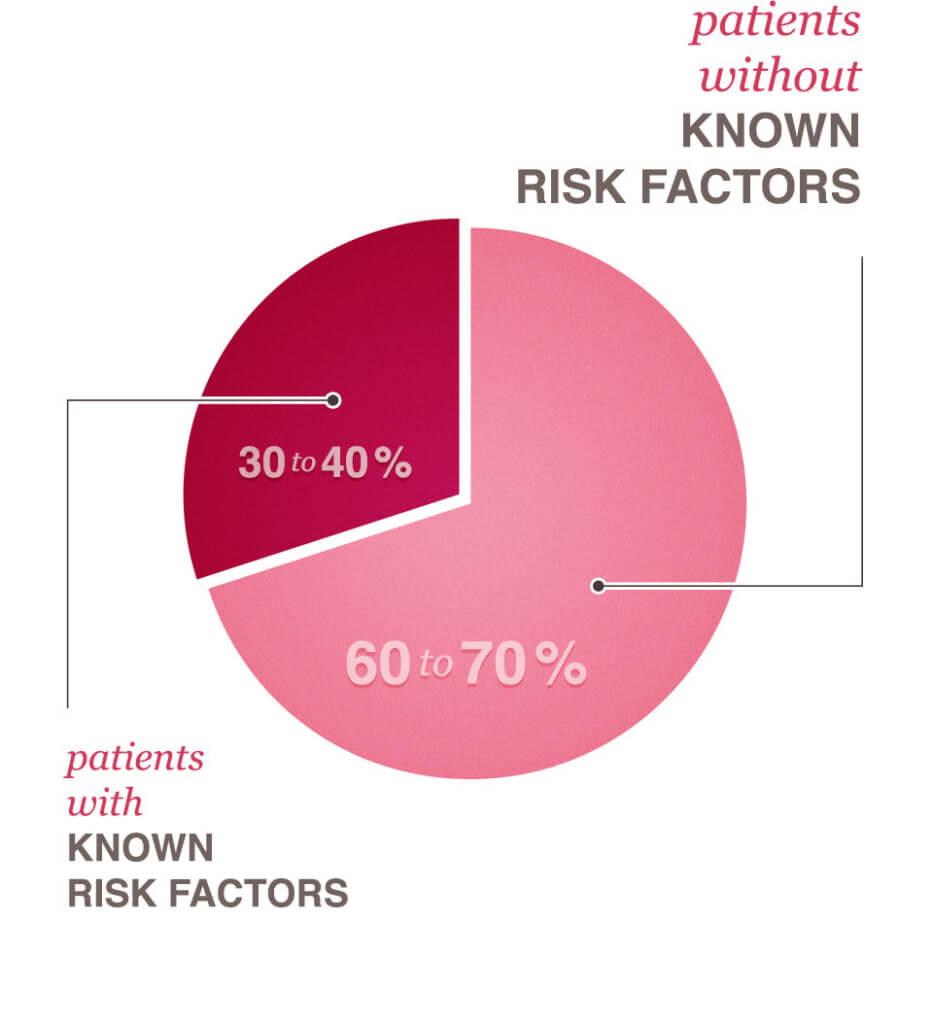
60-70% of people with breast cancer have no connection to these risk factors at all, and other people with risk factors will never develop cancer.
These do not cause Breast Cancer:
- Breast cancer is not contagious; you can’t contract cancer from a person who has the disease.
- Breast cancer is not caused by wearing underwire bras, implants, deodorants, antiperspirants, mammograms, caffeine, plastic food serving items, microwaves, or cell phones, as breast cancer myths often suggest.
Causes of Breast Cancer: How did this happen?
When you’re told that you have breast cancer, it’s natural to wonder what may have caused the disease. But no one knows the exact causes of breast cancer. Doctors seldom know why one woman develops breast cancer and another doesn’t, and most women who have breast cancer will never be able to pinpoint an exact cause. What we do know is that breast cancer is always caused by damage to a cell’s DNA.
Known Risk Factors
Women with certain risk factors are more likely than others to develop breast cancer. A risk factor is something that may increase the chance of getting a disease. Some risk factors (such as drinking alcohol) can be avoided. But most risk factors (such as having a family history of breast cancer) can’t be avoided. Having a risk factor does not mean that a woman will get breast cancer. Many women who have risk factors never develop breast cancer.
Breast Anatomy
As you learn about breast cancer, you will likely hear medical terms referring to the anatomy of the breast. Understanding the different parts and functions of the breast will help you better grasp the details of breast cancer.
Knowing details about your breasts, the way they function, and body systems helps you to:
- Make informed decisions.
- Have a better dialogue with your doctor.
- Be aware of anything unusual.
Adipose Tissue
The female breast is mostly made up of a collection of fat cells called adipose tissue. This tissue extends from the collarbone down to the underarm and across to the middle of the ribcage. As a woman ages, especially once she reaches menopause, the breast tissue contains more adipose (fatty) tissue.
Lobes, Lobules & Milk Ducts
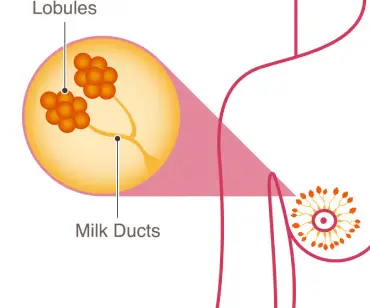
A healthy female breast is made up of 12–20 sections called lobes. Each of these lobes is made up of many smaller lobules, the gland that produces milk in nursing women. Both the lobes and lobules are connected by milk ducts, which act as stems or tubes to carry the milk to the nipple. These breast structures are generally where the cancer begins to form.
Lymph System
Also within the adipose tissue is a network of ligaments, fibrous connective tissue, nerves, lymph vessels, lymph nodes, and blood vessels. The lymph system, which is part of the immune system, is a network of lymph vessels and lymph nodes running throughout the entire body.
Similar to how the blood circulatory system distributes elements throughout the body, the lymph system transports disease-fighting cells and fluids. Clusters of bean-shaped lymph nodes are fixed in areas throughout the lymph system and act as filters by carrying abnormal cells away from healthy tissue.
Breast Tumors
What is a tumor?
A tumor is a mass of abnormal tissue. There are two types of breast tumors: those that are non-cancerous, or ‘benign’, and those that are cancerous, which are ‘malignant’.
Benign Tumors
When a tumor is diagnosed as benign, doctors will usually leave it alone rather than remove it. Even though these tumors are not generally aggressive toward surrounding tissue, occasionally they may continue to grow, pressing on other tissue and causing pain or other problems. In these situations, the tumor is removed, allowing pain or complications to subside.
Malignant Tumors
Malignant tumors are cancerous and may be aggressive because they invade and damage surrounding tissue. When a tumor is suspected to be malignant, the doctor will perform a biopsy to determine the severity or aggressiveness of the tumor.
Metastatic Cancer
Metastatic cancer is when cancer cells of a malignant tumor spread to other parts of the body, usually through the lymph system or by using the blood stream and form a secondary tumor. These secondary tumors, known as metastatic disease, are still made up of breast cancer cells, but are now located inside other organs, such as the bones, liver, or lungs.
Tumor Grades
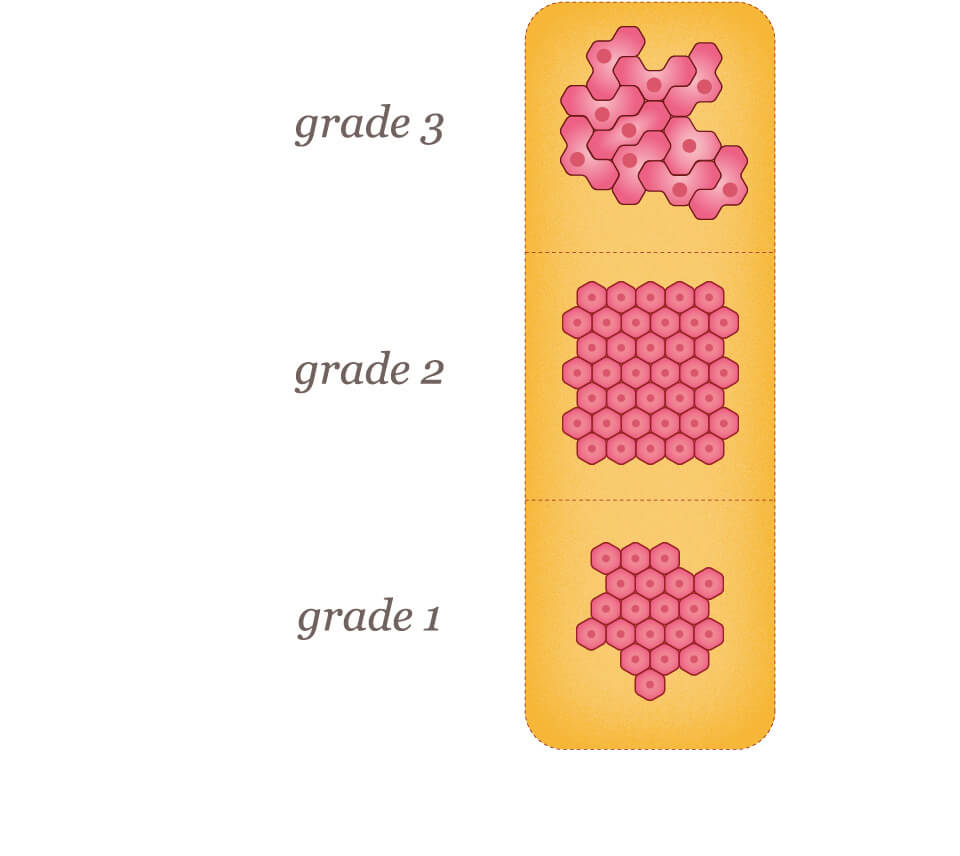
Tumor grading is a system used by pathologists to classify a malignant breast cancer tumor based upon the severity of the mutation and the likelihood that it will spread. The breast cancer cells are examined under a microscope to determine, among other factors, how closely the breast cancer cells resemble the healthy cells (called the histologic grade) and the shape and size of the tumor cells’ nuclei (called the nuclear grade) as well as how rapidly those cells divide and multiply.
When dealing with breast cancer, tumors are often graded based on a scale of one to three indicating how aggressive the cancerous cells are:
- Low grade (1) – Well-diffentiated
- Intermediate grade (2) – Moderately differentiated
- High grade (3) – Poorly differentiated
Low grade tumors look more like normal tissue under the microscope. High-grade tumors look abnormal and less like normal tissue and tend to be more aggressive.
 Breast cancer tumor grades are not to be confused with cancer stages. Tumor grades help to determine the best treatment plan, and in general, a lower grade tumor means a better chance for a full recovery. However, there are individuals who make full recoveries at every stage and with even the highest grades of aggressive tumors.
Genetic Testing for Breast Cancer
Who should be tested for Breast Cancer?
While BRCA1 and BRCA2 gene mutations may increase your odds of developing breast cancer, your odds of having either mutation are pretty small. An estimated 0.25% of the general population carries a mutated BRCA gene, or about one out of every 400 people.
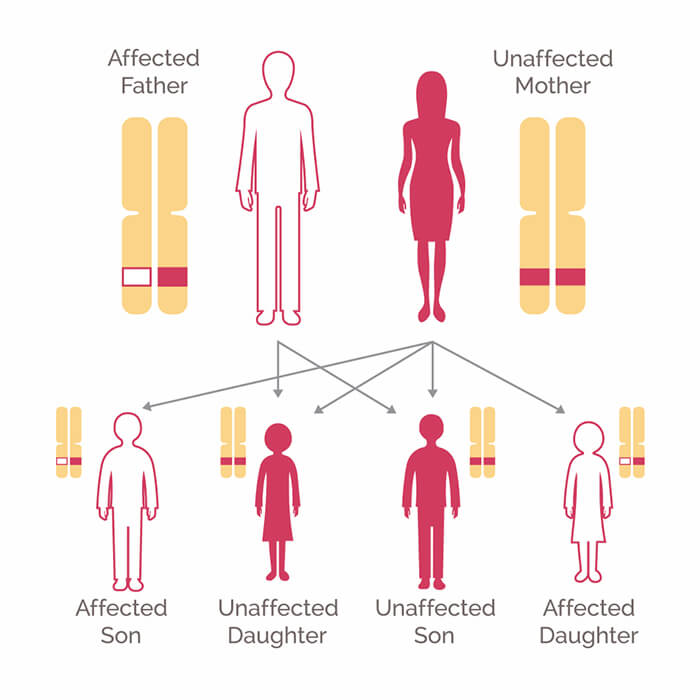 For some people, though, the chances of having a BRCA gene mutation are much higher. Genes are inherited, which is why knowing your family history is important when determining breast cancer risks. If one of your parents has a BRCA mutation, you have a 50% chance of inheriting the mutated gene.
Odds can also vary depending on a person’s ethnicity. For example, people of Ashkenazi Jewish descent have a 2.5% chance of inheriting a BRCA mutation, or about 10 times the rate of the general population.
Because the overall odds are so low, most experts recommend that only people with a heightened risk get tested for BRCA mutations. Likewise, insurance companies often only cover genetic counseling and testing for individuals who are at high risk. A person could be considered at high risk for BRCA mutations if they have a family history of:
- Breast cancer diagnosed before age 50.
- Male breast cancer at any age.
- Multiple relatives on the same side of the family with breast cancer, particularly if they are first-degree relatives (mother, sister, daughter).
- Multiple breast cancers in the same woman, meaning breast cancer developing in both breasts over time or at the same time.
- Both breast and ovarian cancer in the same woman.
- A history of ovarian cancer in the woman’s family, especially if a first-degree relative.
- Ashkenazi Jewish heritage.
- A significant history on the same family side (mother or father’s side) of men diagnosed young with prostate cancer, ovarian cancer in female family members, melanoma, or pancreatic cancer. (These can be signs of a BRCA2 gene mutation present in the family.)
There are also other gene mutations besides BRCA that could increase the risk of breast cancer. The most prominent of these is PALB2. As with BRCA1 and BRCA2, testing for other genetic mutations is recommended only if you are at high risk for that particular gene.
How to get BRCA genetic tested
Genetic counseling is recommended for those who are interested in being tested for breast cancer gene mutations. You can talk to a doctor about getting a referral to a genetic counselor, who can help determine whether genetic testing would make sense based on family history and risk factors. Since many genetic tests only look for one specific gene mutation, the counselor can often help determine which mutations to test for.
The genetic test itself simply involves taking a small sample of blood or saliva, which is sent to a lab for analysis. Results can take several weeks or months.
Genetic testing results are not always clear-cut:
- A test result can be positive, meaning that the patient does carry the gene mutation.
- A negative test result indicates that they do not have that particular known gene mutation. It does not, however, rule out the possibility of having mutations in other genes. It also does not rule out the possibility of developing breast cancer. Most breast cancer cases are not hereditary, so everyone should still have an early detection plan.
- Genetic test results can also be uncertain or ambiguous. An ambiguous test result means that a mutation has been found on the gene, but it is not yet known whether that particular mutation has any effect on the chances of developing breast cancer.
- Someone is either negative or positive. Over time, a person cannot go from being negative to being positive or vice versa for the specific gene mutations they were tested for.
After receiving genetic test results, a patient should meet again with a genetic counselor to clarify what the results mean. Whether the results are positive, negative, or ambiguous can impact many life decisions, and a counselor can help navigate those decisions.
Genetic testing can be scary. The results also can impact other family members such as siblings and offspring; when someone tests positive for a gene mutation, their siblings and offspring will have a 50% risk of also testing positive. Having a discussion with a genetics counselor first is encouraged so a discussion about the potential scenarios can take place.
For a woman who tests positive for BRCA1 or BRCA2 gene mutation, bilateral mastectomies are usually recommended particularly if she has just been diagnosed with breast cancer.
What to do if you test positive for Breast Cancer
It’s natural to feel worried if you’ve tested positive for a BRCA1, BRCA2, or PALB2 gene mutation. It’s true that these gene mutations can significantly increase your chances of developing breast cancer. However, it’s important to keep in mind that many people who carry such gene mutations never develop breast cancer. Even for those who do, early diagnosis and treatment make it very likely that they will overcome the disease. With early detection, the vast majority of people survive breast cancer and go on to live full, normal lives.
Early Detection Plans
People with BRCA or PALB2 gene mutations have a higher-than-average chance of developing breast cancer and are more likely to develop it at a younger age. Women with a BRCA1 or BRCA2 mutation can have a 45 – 65% chance of being diagnosed with breast cancer before age 70. For PALB2 mutations, 33% will develop breast cancer by that age.
The good news is that, with this knowledge, you can create a custom early detection plan with your doctor to increase the chances that your breast cancer is detected early. Early detection makes breast cancer far easier to treat. Overall, the five-year relative survival rate for breast cancer detected in the localized stage (there is no sign that the cancer has spread outside of the breast) is 99%.
An early detection plan for someone with a BRCA or PALB2 gene mutation will likely involve more frequent breast cancer screenings starting at a younger age. It may also involve different types of screenings, such as ultrasound or MRI scans. Your doctor can help recommend which screenings you should have, and when you should have them.
Preventative Surgery
Though some consider it extreme, women with high-risk BRCA mutations may choose to undergo preventative surgery to help reduce the risk of developing breast cancer.
A preventative double mastectomy (or bilateral prophylactic mastectomy) is the surgical removal of both breasts before cancer has a chance to develop and/or spread. There are different types of preventative mastectomies; some remove the entire breast, while others leave the skin and nipples intact to aid in breast reconstruction surgery.
Actress and filmmaker Angelina Jolie drew public attention to using surgery to proactively address BRCA gene mutations when she publicly shared her story of undergoing a preventative double mastectomy. She later chose to also have her ovaries and fallopian tubes removed, a procedure known as a preventative salpingo-oophorectomy.
Removing ovaries and fallopian tubes are commonly recommended as a way to reduce breast cancer risk, as well as ovarian cancer risk. For women not diagnosed with either type of cancer, it can be helpful to talk with a genetics counselor about the timing of when to do preventative surgeries. If a woman is still of childbearing age, she likely will want to delay getting her ovaries and fallopian tubes removed until she has finished birthing her family.
Though such preventative or prophylactic surgeries decrease the risk of developing breast cancer by more than 90%, they don’t eliminate the risk entirely. Surgery itself also carries its own set of risks and costs, which need to be carefully considered. Your doctor can help you understand the options and risks and make the choice that is right for you.
BRCA, Gene Mutations, & BC Treatments
If someone with a BRCA mutation does develop breast cancer, the treatments used may be different than for people who do not carry the gene mutation.
People with BRCA1 mutations are more likely to develop triple negative breast cancer. Triple negative breast cancer does not respond to hormone therapy or certain drugs. However, chemotherapy may be more effective at treating triple negative cases than it is against other types of cancer.
Breast cancer patients with BRCA1 or BRCA2 mutations are also more likely to later develop a second cancer, either in the same or the opposite breast. Because of this, they may opt for a double mastectomy instead of a single or partial mastectomy (also known as lumpectomy). Removing the healthy breast along with the cancerous one is essentially another form of a preventative mastectomy.
Though research is still ongoing, some findings indicate that certain types of cancer treatment drugs might be more effective than others in patients with BRCA gene mutations.
As always, your doctor can help determine which breast cancer treatments are right for you.
Other Considerations
There are many emotions and decisions that come along with a positive BRCA mutation test result. Feelings can range from fear to anger, sadness, or guilt. There can be questions about whether your children or other family members should be tested. For some, it can affect the decision of whether or not to have children. You may have concerns about passing on the mutated gene to your offspring; some women even choose preventative surgeries that can make it difficult or impossible to have children.
Genetic counselors can help you navigate the waters and understand all the risks, decisions, and emotions involved.
Help is available; you don’t have to go through this alone.
Florida Chicken Tortilla Soup

Ingredients
2 to 3 Florida chicken breasts (cooked and diced into bite-size chunks)
2 ears fresh Florida sweet corn, cut off the cob
2 Florida bell peppers (your favorite color), diced
2 Florida tomatoes, diced small
1 small onion, diced small
1 jalapeno (remove seeds to lessen the heat), finely chopped
1 poblano pepper, diced small
3 cloves garlic, minced
1 small can green chiles
2 cans black beans, rinsed
2 tablespoons chili powder
1 tablespoon cumin
1 tablespoon oregano
6 cups low sodium chicken broth
2 cups water
1 lime, juiced
Hot sauce (your favorite)
5 small corn tortillas, cut into long thin strips
Olive oil for cooking
Sea salt and fresh ground pepper, to taste
Preparation
Preheat a large skillet; carefully add the oil. sauté the onions, bell peppers, jalapeno, poblano and corn until soft; about 8 minutes. Add the minced garlic, tomatoes and green chilis and cook for additional 5 minutes. Next, add rinsed black beans, chili powder, cumin and oregano. Stir all the ingredients to combine. Pour in the chicken broth and water; add the diced chicken and tortilla strips. Cover and simmer for 30 minutes, finish with fresh lime juice. Taste and adjust seasoning as needed. Serve with fresh avocado, sour cream and crushed tortilla chips if desired.
